
You might already be a Business for Good
(and not even know It)
Understanding social enterprise and why South Australia is full of businesses already doing it.
What if the business you're already running, or the idea you've been quietly nurturing, is already a social enterprise?
What if doing good and doing business aren't opposites, but the same thing?
Let's start with an honest observation: the term "social enterprise" can feel like jargon. It can sound like something that belongs in a policy document or a grant application, not in a conversation between real people building real businesses. So let's set that aside for a moment and just talk about what it actually means.
So what is a social enterprise?
A social enterprise is a business. It sells products and services, earns income through trade, and operates in the real economy. But unlike a traditional business (which exists primarily to generate profit for its owners or shareholders) a social enterprise exists to tackle a social, environmental, or cultural problem. Its mission is baked into its model.
Social enterprises are not all charities. They don't rely on donations, grants, or philanthropy to survive. They make money, but they use that money, and their energy, deliberately and purposefully. They are mission-led and trade-based. They have the heart of a community organisation and the brain of a business.
The Business for Good Spectrum
One of the most useful ways to understand social enterprise is to picture a spectrum. On one end, you have community and welfare organisations - mission-driven entities that exist entirely for social good, but depend almost entirely on philanthropy, grants, and volunteers to operate. On the other end, you have mainstream commercial businesses - entities that sell products and services primarily to maximise profit for their owners.
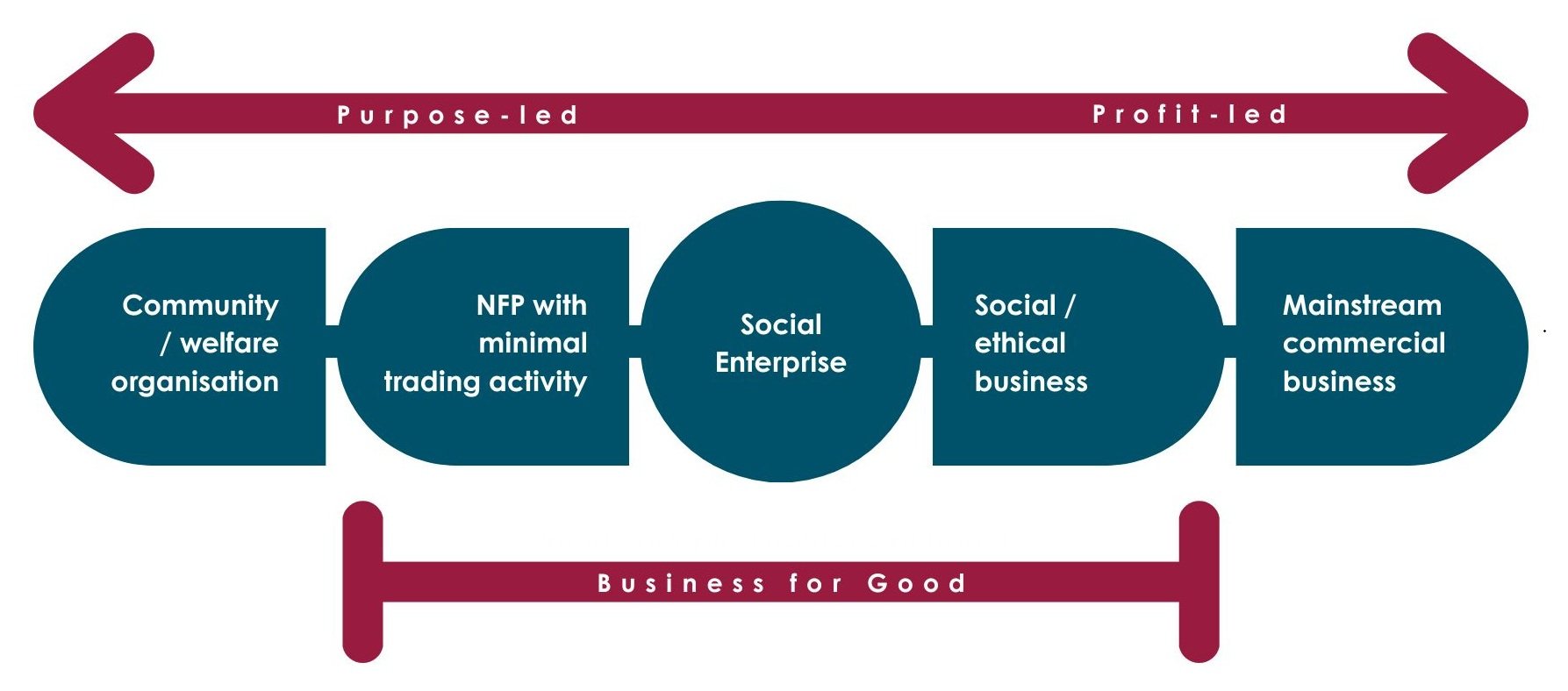
Image adapted from Social Traders
Social enterprise sits right in the middle of this spectrum. But here's the important thing: Business for Good is bigger than social enterprise alone. It encompasses anyone on this spectrum who is doing business with genuine purpose, from a not-for-profit that does some trading, all the way to an ethical business or a B Corp that has embedded responsibility into how it operates.
And that's why we often use the term "Business for Good" - because it's a bigger, more welcoming tent. It's about direction and intention, not a single fixed category.
What does a social enterprise actually look like?
This is where it gets interesting and where a lot of people are surprised. Social enterprises don't all look the same. They exist in almost every industry, and they operate through a few different models. Here are three of the most common.
MODEL 1: THE INCLUSIVE EMPLOYMENT MODEL
Creating employment pathways where they didn't exist
Some social enterprises are built specifically to employ people who face significant barriers to entering the workforce. Redrawn is an engineering consultancy delivering industrial design across mining, energy, water and infrastructure — and it deliberately creates pathways for engineers and designers from underrepresented backgrounds. Their first employee, Kim, is deaf. Rather than treating that as a barrier, the whole team learned sign language to communicate inclusively. In most workplaces, Kim was never given the chance, but at Redrawn he's one of their most exceptional engineers. That's what inclusive employment looks like in practice.
MODEL 2: THE COMMUNITY NEED MODEL
Solving problems the traditional business market ignores
Some social enterprises exist specifically to tackle a community need that traditional business doesn't address, often because the profit margin isn't attractive enough. Tailem Bend Community Centre is a wonderful example; an independent organisation that provides low-cost training and courses for their local community, runs a passenger network to transport elderly residents to medical appointments, and is developing a social enterprise training space where young people learn desirable skills that will increase their opportunities in the job market.
Circular economy models often align with this community need. Woodland Pantry rescues surplus produce from regional farmers (produce that might otherwise go to waste), pays those farmers for it, and transforms it into value-added dehydrated meals like soups and risottos. Farmers get extra income from their second-grade produce. Food waste is reduced. Customers get genuinely nutritious, delicious products. Everyone wins.
MODEL 3: THE REINVESTMENT MODEL
Impact built into the business model
Some social enterprises sell products or services in the traditional way to paying customers, but reinvest their profit or energy resources directly into their mission. This can look like subsidising their own additional impact activities, or donating profits to a parent impact organisation to further its impact, or donating to a third party humanitarian project partner to deliver the impact in a particular setting or population. Taboo is a great South Australian example: they sell certified organic, biodegradable cotton pads and tampons, and all of their profits go towards education and activities that combat period poverty. Customers can even donate products directly to people in need through a dedicated program.
Another local example from the Business for Good community is SpellShield Technologies, a cybersecurity business that provides strategic guidance for modern workplaces and gives back by offering subsidised or pro bono services to organisations that need protection but couldn't otherwise afford it. They charge standard rates to commercial clients so they can support the organisations doing good work in our community.
A note on First Nations businesses
First Nations businesses deserve a special mention here, and not as an afterthought. Many First Nations businesses are social enterprises not because they've adopted a label, but because they come from a culture that has always put community and Country first. A business created by a First Nations person who holds community and culture at the centre of everything they do is, by its very nature, a business for good.
It's also worth being honest about something: the social enterprise sector has not always made space for First Nations businesses. The language of "enterprise," "impact," and "sustainability" doesn't always reflect Indigenous ways of being, even when those businesses are, in fact, guiding the way. As First Australians Capital notes in their report on Indigenous economic inclusion, Indigenous enterprises have existed long before the social enterprise sector was ever named, and the sector still has some catching up to do.
What we know is this: Indigenous businesses naturally operate with their communities and lands at the heart of what they do. They use business as a path to economic self-determination and community wellbeing. That is social enterprise. That is business for good. And we are proud to welcome First Nations businesses into this space - on their own terms, without requiring them to adopt terminology that doesn't fit.
This is already happening… at scale
One of the most common reactions people have when they first really understand social enterprise is: "Wait, there are businesses doing this already? Near me?"
Yes. Many of them. And the numbers are striking.
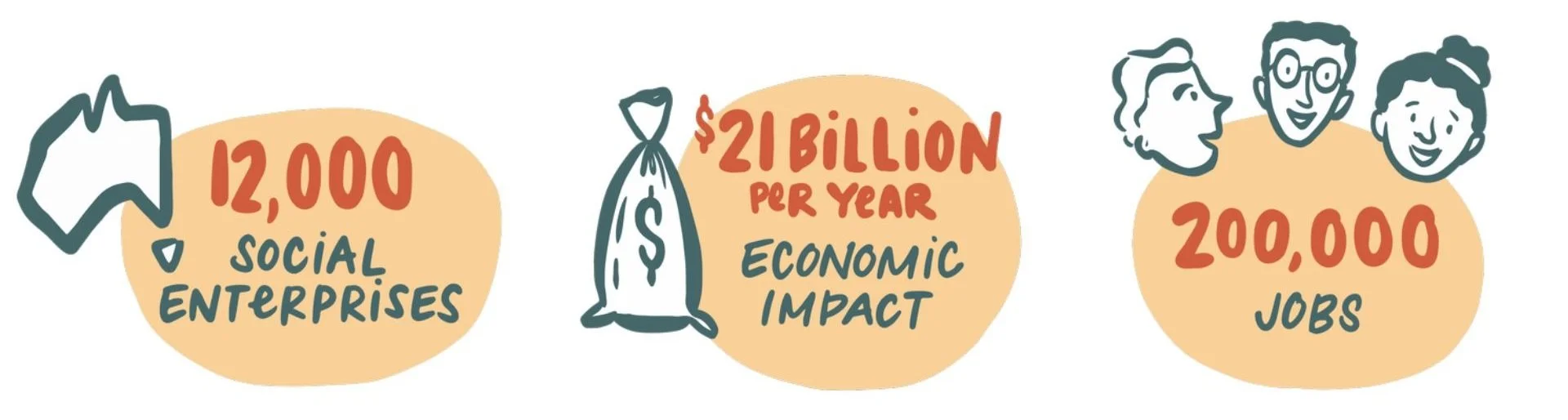
Source: Social Enterprise Australia, 2021
There are over 12,000 social enterprises in Australia. They contribute $21.3 billion to the economy, which is 1% of GDP. They employ over 200,000 people - about one in 60 jobs - which is the same number of people as the arts and recreation services industry… or the mining sector. That's not a niche. That's a movement.
And many of those businesses don't call themselves social enterprises. They're community centres, engineering firms, food businesses, tech companies, and tradespeople who simply built their business around something they cared about. The label is optional. The intention is what matters.
"There are so many businesses around you that already operate as a social enterprise — without even knowing it. The reason for this article is to help people look for them, connect with them, and recognise themselves in them."
We include ourselves in that. Collab4Good is a South Australian social enterprise, with 100% of our profits reinvested into supporting social enterprises and First Nations businesses. We're not just facilitating this program from the outside, we're part of the same ecosystem, with the same commitment to building an economy that works for people and planet.
Why this matters more than ever
The world is changing, and not quietly. Environmental degradation, growing inequality, social fragmentation, and economic instability are creating problems that traditional business models were not designed to solve. At the same time, younger generations are entering the workforce and the marketplace with clear expectations: they want to work for, buy from, and build businesses that actually take responsibility for the world around them.
Social enterprise is a real, practical response to this moment. It's not about charity, or sacrifice, or operating at a loss. It's about building businesses that are genuinely sustainable - financially, socially, and environmentally - because they've embedded responsibility into how they operate from day one. It's not just about how many people you employ, but who you employ and how you support them. Not just how much money you make, but what you do with it.
The businesses doing this well aren't just doing good. They're building something that’s really future-proof.
If this resonates with you - we'd love to meet you!
The Business for Good Program exists for South Australian businesses that are already doing this, businesses that want to start, and businesses that are somewhere in between and figuring it out.
Whether you want to sharpen your business model, connect with other purpose-driven businesses, understand your social impact better, or simply be in a room with people who get it… the program has a place for you.
Program activities include:
Workshops - practical, hands-on sessions covering Business Fundamentals, Business Model Design, Marketing, Financial Management, Raising Capital and more. $30 per workshop.
1-on-1 Coaching - tailored, confidential business support across a wide range of topics. $45 per session.
Group Mentoring - facilitated peer learning sessions every two months, hosted by the South Australian Social Enterprise Council. $20 per session.
An Equitable Access Policy is available if fees are a barrier. Contact hello@sasec.org.au to find out more.
Learn more about the program and sign up: sasec.org.au/Businessforgood
Who is eligible?
Holds a current Australian Business Number (ABN)
Principal place of business in South Australia
A small business (fewer than 20 FTE employees) or family business
Committed to learning and understanding how you can embed impact into your business
Not sure if you're eligible? Get in touch at hello@collab4good.com.au or hello@sasec.org.au
The Business for Good Sector Development Program 2025-27 is an initiative of the Government of South Australia’s Office for Small and Family Business and the South Australian Small Business Strategy 2023 – 2030. Delivered in partnership by the South Australian Social Enterprise Council (SASEC) and Collab4Good, the 2-year Business for Good Program is supporting South Australian small social enterprise businesses with key business fundamentals to strengthen their knowledge, capacity and capability to deliver social, environmental and economic outcomes for SA with long-term business sustainability and growth.
Collab4Good
A South Australian social enterprise intermediary building the capacity and capability of learners, leaders and businesses to deliver positive social impact through enterprise and business. Collab4Good brings people together to lead, learn, connect, and collaborate towards a shared vision for a just economy - and reinvests 100% of its profits into supporting social enterprises and First Nations businesses.
South Australian Social Enterprise Council (SASEC)
The independent, non-political, member-based peak body dedicated to representing the interests of South Australian social enterprises — and to supporting and building a flourishing social enterprise sector in South Australia.